
Don’t Miss:
- Federal court vacates key aspect of No Surprises Act’s IDR process
- President calls for changes in childhood immunizations
- CMS seeks billing info so it can pay APM docs their bonuses
The following is the latest health policy news from the federal government for August 7-13. Some of the language used below is taken directly from government documents.
The White House
 The White House has issued an executive order calling for a change in recommended childhood vaccines. The order suggests reducing the number of recommended childhood vaccines from the current 17 to 11 revising the status of the remaining six currently recommended vaccines to “recommended for certain high-risk groups or populations” or “immunizations based on shared clinical decision-making.” The executive order also states that “… the combined measles, mumps, rubella (MMR) vaccine should be administered in three separate single-disease shots once such products are domestically available and that, to the maximum extent feasible, all childhood immunizations should be administered at separate medical visits.” The order directs the Secretary of HHS, through the HHS Task Force on Safer Childhood Vaccines, to present plans for implementing this order to the President within 90 days and calls on the states to update relevant laws and regulations that define the scope of immunization requirements for contexts such as school enrollment and attendance. Officially, vaccine recommendations are made to the director of the CDC by the CDC’s Advisory Committee on Immunization Practices. Also, even these recommendations are not binding on states for the purpose of determining whether children can attend public schools. Learn more from this executive order and an accompanying White House fact sheet.
- At the same time, HHS is soliciting nominations for appointment to its National Vaccine Advisory Committee. This committee, which currently has no members, recommends ways to achieve optimal prevention of human infectious diseases through vaccine development and provides direction to prevent adverse reactions to vaccines. It presents its advice to HHS’s Assistant Secretary for Health, who serves as the director of the national vaccine program. Learn more about the work of the committee and its members, the background HHS seeks among potential members, and how to submit nominations from this HHS notice. The deadline for submitting nominations is September 11.
Congress
 Before leaving for August recess, the Senate passed its version of a continuing resolution (CR) in a 90-6 vote; it would extend federal government funding through December 11.
-
- Because appropriations bills have not cleared both chambers of Congress and are not identical, the federal government faces a September 30 funding deadline and will require a CR to avoid a lapse in spending authority. Both chambers must pass identical bills for a CR to become law.
- The House is expected to return on August 31 and the Senate on September 14.
The Courts – No Surprises Act Decision
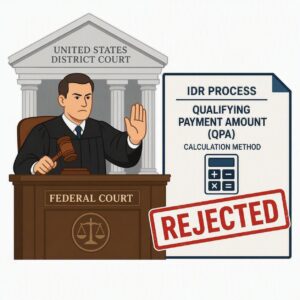 A federal appeals court has rejected how health care payers calculate their qualifying payment amount, or QPA, when addressing disputed payments under the No Surprises Act’s Independent Dispute Resolution (IDR) process. The QPA is the central benchmark rate payers present to help settle out-of-network medical billing disagreements – as the court described it, “… the median of the total maximum rates in an insurer’s contract for an item or service that a provider provides and furnishes, sorted by specialty and geographic region.” The court concluded that payers should not be permitted to include so-called ghost rates when calculating their QPA; a ghost rate is a rate for services that a given provider does not actually provide, leaving the provider no incentive to attempt to negotiate that rate and, until now, freeing payers to establish contract rates for such services as low as one dollar, thereby skewing insurers’ calculation of the QPAs they present as the basis for their negotiating position in the IDR process. The case was brought by the Texas Medical Association and others and decided by a federal appeals court in that state. The court’s ruling vacates the current process through which payers calculate their QPAs and addresses other aspects of the IDR process as well. Learn more about the decision from the court’s opinion in the case.
Centers for Medicare & Medicaid Services (CMS)
 In June, HHS, the departments of Labor and the Treasury, and the Office of Personnel Management published federal Independent Dispute Resolution (IDR) operations final rules to improve the functioning of the No Surprises Act’s IDR process by streamlining communication between health care payers, providers, and certified IDR entities and by establishing new timelines and processes. The requirements in these final rules have varying applicability dates, many of which depend on the availability of the operational functionalities within the new, soon-to-be-introduced IDR Gateway. Now, in a new guidance document, CMS is clarifying the applicability dates for the various processes and requirements established in the June rule and the implementation approach for each provision. Learn more from CMS’s guidance on the implementation of its June 2026 IDR rule.
- CMS has issued a final rule ending the use of federal funding for sex-changing procedures for children and youth under the age of 18 for Medicaid beneficiaries and under the age of 19 for CHIP participants. Such procedures include puberty blockers, cross-sex hormones, and surgical operations. Under the final rule, which applies only to federal Medicaid and CHIP funding, that funding will remain available for a tapering-off period of up to six months from the effective date of the final rule for children currently on hormone therapy. The rule does not affect coverage of mental health services; Medicaid’s Early and Periodic Screening, Diagnostic, and Treatment (EPSDT) provisions will continue to ensure comprehensive coverage of mental health services for eligible children; and CHIP will continue to require coverage of necessary mental health services in accordance with federal law. Learn more about the final rule and its underlying rationale from this CMS news release and the rule itself. The rule takes effect on October 13.
- CMS has issued an advisory explaining that it does not have current billing information for some clinicians who are qualifying Alternative Payment Model (APM) participants and are eligible to receive APM incentive payments. Such providers need to submit their current billing information to CMS by October 13 to receive their payments. After that date, any claim to APM incentive payments for the 2026 payment period, which is based on the 2024 performance period, will be forfeited. Learn more about the incentive payments, how to determine if CMS has the information it needs to make incentive payments to specific providers, and how to submit the necessary data from this CMS notice.
- CMS has posted a bulletin presenting its prospective payment system web pricer changes for FY 2027 under the Medicare inpatient rehabilitation facility prospective payment system. Among the changes it addresses are the rural transition policy and the wage index cap. Find the bulletin here. The changes it presents take effect on October 1.
- CMS has posted a bulletin announcing that it is extending the default recoupment date for part A cost report overpayments and revision of the Medicaid check criterion for debts submitted for close-out. Among the affected providers are hospitals, skilled nursing facilities, home health agencies, hospices, and others that bill for Medicare Part A services. Learn more about the changes and why the agency is making them from this CMS bulletin. The new policy takes effect on January 4.
- CMS has posted a bulletin presenting its FY 2027 updates for Medicare severity diagnosis-related groups (MS-DRGs) subject to the inpatient prospective payment system’s replaced devices policy. The policy changes described in the bulletin affect hospitals, other providers, and suppliers. Find the bulletin here. The changes it presents take effect on October 1.
- CMS has issued a request for information (RFI) seeking feedback from Medicaid Enterprise System (MES) stakeholders to inform the development and implementation of its MES IT standards program. The goal of this RFI is to gather specific, actionable information to ensure that the program effectively addresses the most significant barriers to MES transformation. CMS seeks input from state Medicaid agencies, MES technology vendors, systems integrators, standards development organizations, health care providers, and other industry experts. Learn more from this CMS announcement, which includes a link to a downloadable copy of the RFI. The deadline for submitting responses is September 25.
- CMS has published a procedural notice with comment period outlining a faster way it will use for manufacturers to get new devices covered by Medicare: its “Regulatory Alignment for Predictable and Immediate Device” (RAPID) coverage pathway. First announced by CMS and the Food and Drug Administration (FDA) in April, this new Medicare coverage pathway will accelerate beneficiary access to eligible Class II FDA-designated breakthrough devices participating in the FDA’s Total Product Life Cycle Advisory Program and to eligible Class III FDA-designated Breakthrough Devices. Under the RAPID coverage pathway, CMS and the FDA will use existing programs and coverage frameworks to analyze and approve in a more timely and predictable way those devices that demonstrate positive clinical health outcomes in the pre-market phase. Learn more about the new process from this CMS news release and this formal CMS notice. The deadline for stakeholders to submit written comments is October 13, after which CMS will respond to comments in a final notice.
- CMS has added the following item to its Quality Payment Program resource library. (Note: clicking these links may give a prompt to download a file that may be a zip file.)
Department of Health and Human Services (HHS)
 HHS has released a report describing what it charges is fraudulent coding for sex-rejecting procedures on minors. Drawing on a variety of sources, the report maintains that nationwide claims data from 2015 through 2025 identifies approximately $50 million in insurance claims for puberty blockers and that another nearly $11 million in claims for patients ages 13-17 were billed using a diagnosis code for precocious puberty – findings the report says warrant additional review of insurance coding practices. Hospitals and clinics identified in the report have been referred to the Justice Department and HHS’s Office of the Inspector General for possible violations of federal law. Learn more from this HHS news release, which includes a link to the report.
- HHS’s Health Resources and Services Administration (HRSA) has announced a modernized framework for addressing national newborn screening topics, including evaluating conditions included in the Recommended Uniform Screening Panel, the national guideline that informs newborn screening programs across the country. HRSA is providing supplemental funding to the Association of Public Health Laboratories through the National Center for Newborn Screening Systems Excellence, which will convene a new stakeholder workgroup and develop findings and recommendations for HRSA’s review and consideration. Learn more from this HRSA news release and this Federal Register notice.
- HHS has declared a public health emergency for the state of Washington to address the health effects of the continuing wildfires in that state. Those fires have threatened communities across the state, disrupted health care services, and required some hospitals and other health care facilities to evacuate patients and transfer them to partner facilities to ensure continuity of care. Learn more from this CMS news release; this news release from HHS’s Administration for Strategic Preparedness and Response (ASPR), which is coordinating the federal response with Washington state officials; President Trump’s emergency declaration; and this guide to the Washington emergency declaration (scroll down to “Wildfires – State of Washington”).
- HHS, the White House Office of National Drug Control Policy, and the Department of Housing and Urban Development have released a toolkit with strategies to help individuals transition from homelessness and addiction to recovery and self-sufficiency. Learn more from this HHS news release and “Best Practices Toolkit: Addressing Homelessness and Addiction Through Treatment First.”
- HHS has announced a $4 million initiative to expand access to rapid, point-of-care syphilis testing, with a focus on reaching women in emergency departments and other non-traditional health care settings such as maternal and child health programs, correctional intake settings, substance use treatment programs, and others. Learn more from this HHS news release.
Medicaid State Plan Amendments
 CMS has approved state plan amendments for Medicaid and CHIP programs for the following states:
- Arizona, reallocating disproportionate share hospital (DSH) pool 4 funds to pool 5
- Arizona, updating the DSH pool 5 payments and participant list
- Florida, updating the clinic services pages, including the Four Walls exception
- Michigan, updating the payment methodology for speech and oral function therapy
- Minnesota, implementing a series of changes in payment methodologies
- Montana, amending the EPSDT program
- Nevada, updating the DSH payment time period
- Nevada, updating dental services rates
- Oklahoma, providing assurances for pre-release services for eligible juveniles incarcerated in a public institution post adjudication of charges
- Pennsylvania, establishing a new class of supplemental Medicaid payments for hospitals providing trauma and burn care
- Pennsylvania, continuing supplemental Medicaid payments to hospitals providing a high volume of services to Medicaid patients in non-rural medically underserved areas
- Pennsylvania, authorizing a supplemental Medicaid payment to certain non-public nursing facilities in a county of the second class
- Pennsylvania, continuing a supplemental payment to certain non-public nursing facilities in a county of the first class
- Pennsylvania, authorizing an additional payment to non-public and county nursing facilities in a county of the first class
- Pennsylvania, authorizing an additional payment to non-public and county nursing facilities that previously qualified for supplemental ventilator care and tracheostomy care payments
- Pennsylvania, authorizing a supplemental payment to certain non-public nursing facilities in a county of the eighth class
- Pennsylvania, authorizing a supplemental payment to certain non-profit nursing facilities in a city of the second class
- Rhode Island, adding mobile response and stabilization services
- Utah, rebasing durable medical equipment payments
- Utah, removing outdated pages for targeted case management services for HMO enrollees
- Virginia, updating supplemental payments for physicians affiliated with Type I hospitals
Health Policy Newsletters, Reports, and Videos
 CMS – MLN Connects – August 13
- CMS has posted the following new videos for health care organizations:
- How to Complete the Transparency in Coverage Template
- How to Complete the Plan ID Crosswalk Template
- How to Complete the Essential Community Providers Section
- Inpatient Rehabilitation Facility Quality Reporting Program training course
- Long-Term Care Hospital Quality Reporting Program training course\
- Overview of the 2027 Proposed Rule for the MIPS Quality Payment Program – video of July 29 webinar
- Meeting ACCESS’ Health IT and Interoperability Requirements – video of July 23 webinar
- HHS/Office of the Assistant Secretary for Planning and Evaluation (ASPE) – “An Overview of State-Directed Payments and Medicaid Provider Taxes: History and Potential Effects of the Working Families and Tax Cut Legislation on Health Care Costs” – August 12 report
- HHS/Office of the Inspector General (OIG) – “This Week at OIG” – August 7 video
- HHS/Health Resources and Services Administration (HRSA) – Organ Procurement and Transplantation Network – Ventilated Patient Form Webinar – July 29 video
- HHS/Administration for Strategic Preparedness and Response (ASPR) – “ Updated Health Care Coalition Response Plan and Surge Annex Templates” – newsletter
- CDC – Morbidity and Mortality Weekly Report (MMWR) – “Trends in Emergency Department Visits Involving Cannabis Hyperemesis Syndrome Identified Using a New Diagnosis Code – United States, January 2023-May 2026.
Centers for Disease Control and Prevention (CDC)
The CDC has issued a health alert advisory notifying clinicians, public health authorities, and the public about the risk of severe arboviral neuroinvasive disease among patients who are receiving B cell-depleting or B cell-modulating medications, particularly anti-CD20 monoclonal antibodies. For more information, see this CDC advisory.
Stakeholder Events
 CMS – Advisory Panel on Hospital Outpatient Payment – August 24
CMS’s Advisory Panel on Hospital Outpatient Payment will meet virtually on Monday, August 24 at 9:30 (eastern). The purpose of this panel is to advise CMS on the clinical integrity of the Ambulatory Payment Classification groups and their associated weights, which are major elements of the Medicare hospital outpatient prospective payment system and the ambulatory surgical center payment system and supervision of hospital outpatient therapeutic services. Interested parties are invited to submit comment letters and presentations. Learn more about submitting such materials and how to participate in the meeting from this CMS notice.
CMS – PEPPER Training for LTCHs, IRFs, and IPFs – August 25
On Tuesday, August 25 at 1:00 (eastern), CMS will hold a webinar to provide training for long-term-care hospitals, inpatient rehabilitation facilities, and inpatient psychiatric facilities on how to access, interpret, and use their latest PEPPER (Program for Evaluating Payment Patterns Electronic Report) report to support data-driven decision-making. Go here to register to participate.
CMS – CCSQ Quarterly Stakeholder Webinar – August 26
CMS’s Center for Clinical Standards and Quality (CCSQ) will provide an update on its work to strengthen health care quality, safety, and coverage and share recent policy developments on Wednesday, August 26 at 11:00 (eastern). Go here to register to participate.
CMS – Healthcare Advisory Committee – August 31
The Healthcare Advisory Committee, created by HHS and CMS to provide non-binding recommendations on modernizing and improving the health care system, will hold its next public meeting virtually on Monday, August 31 at 8:00 (eastern); registration is not required. The deadline for submitting comment letters is August 18. Learn more about the committee, its work, and how to submit comment letters from this formal notice and from the committee’s web site. Webinar information will appear on the meeting’s agenda, which will be posted here; the agenda for the August 31 meeting has not yet been posted. Additional meetings have been scheduled for November 19; February 22, 2027; and May 10, 2027.
MedPAC – Commissioners Meeting – September 3-4
MedPAC’s commissioners will hold their next public meeting virtually on Thursday, September 3 and Friday, September 4. An agenda for the meeting and information about how to participate has not yet been posted; when they are, they will be found here.
CMS – PEPPER Training for Home Health Agencies and Partial Hospitalization Programs – September 24
On Thursday, September 24 at 1:00 (eastern), CMS will hold a webinar to provide training for home health agencies and partial hospitalization program facilities on how to access, interpret, and use their latest PEPPER (Program for Evaluating Payment Patterns Electronic Report) report to support data-driven decision-making. Go here to register to participate.
MACPAC – Commissioners Meeting – September 24-25
MACPAC’s commissioners will hold their next public meeting on Thursday, September 24 and Friday, September 25. An agenda for the meeting and information about how to participate has not yet been posted; when they are, they will be found here.
CMS – PEPPER Training for Skilled Nursing Facilities – September 29
On Tuesday, September 29 at 1:00 (eastern), CMS will hold a webinar to provide training for skilled nursing facilities on how to access, interpret, and use their latest PEPPER (Program for Evaluating Payment Patterns Electronic Report) report to support data-driven decision-making. Go here to register to participate.