The following is the latest health policy news from the federal government for June 5-11. Some of the language used below is taken directly from government documents.
Don’t Miss:
- CMS warns more than 500 hospitals for failing to meet price transparency requirements
- HHS OIG looks at Medicare Advantage rejections of post-acute services
- Federal court rejects $100,000 H-1B visa fee
- HHS RFI seeks new approaches, including AI, for treating addiction
- CMS creates new office to help with tech modernization
 Congress
- Some Republican members of Congress continue to plan for a third party-line reconciliation bill to focus on health care affordability. The House Energy and Commerce Committee and Ways and Means Committee are working on health care bills that could be included in either a reconciliation bill before the end of July or a spending bill, likely at the end of the year.
- The House Energy and Commerce Committee’s Health Subcommittee held a hearing titled “Lowering Health Care Costs for All Americans: Examining Policies to Increase Health Care Transparency.” The committee discussed proposed bills addressing hospital price transparency, transparency for health insurance plans, accountability for Medicare Advantage plans, and transparency of health care-related ownership structures. For more information, see the list of bills the committee considered here and a recording of the hearing here.
- The House Appropriations Committee passed a bill that includes FY 2027 funding for the Department of Health and Human Services. Along with discretionary funding for the department, the bill contains two provisions of note:
- Restricted funding for the implementation of the Prior Authorization for Selected Service and Wasteful and Inappropriate Services Reduction (WISeR) Model. The committee passed a similar provision last year but it did not become law.
- Nursing programs would be designated as professional degree programs for Title IV federal student aid programs.
For more information:
 H-1B Visas
A federal court has rejected the $100,000 application fee set by the Department of Homeland Security and State Department for employers seeking H-1B visas to bring foreign workers to the U.S. to work in specialized roles. In a challenge brought by 20 state governments, the court concluded that the fee constituted a tax and ruled that only Congress, not the executive branch, can levy taxes. H-1B visas are often sought by hospitals, health systems, and other health care organizations to recruit foreign doctors and other skilled health care professionals to the U.S. to help overcome domestic labor shortages. Learn more from the court’s decision in the case.
Centers for Medicare & Medicaid Services (CMS)
- CMS has sent letters to more than 500 hospitals warning them that they are not meeting federal requirements for price transparency or must submit plans to the agency detailing how they intend to address their price transparency shortcomings. Learn more about federal hospital price transparency requirements from CMS’s Hospital Price Transparency web page, which includes an FAQ and a fact sheet, and explore CMS’s Hospital Price Transparency Enforcement Activities and Outcomes web page, which includes a searchable database with regularly updated information about all hospitals that participate in Medicare.
- CMS has announced the creation of a new “Office of Health Technology and Products” that will provide enterprise leadership and oversight for CMS health care technology modernization, digital products, and the transformation of platforms and services supporting Medicare, Medicaid, the Children’s Health Insurance Program (CHIP), and other CMS-administered programs. The new office will work in close coordination with CMS’s chief information officer and will be subject to CIO-led enterprise IT governance, cybersecurity, enterprise architecture, and capital planning and investment control as well as CIO-led digital service delivery, customer experience, and public digital experience responsibilities. Learn more about the Office of Health Technology and Products from this CMS announcement.
 CMS has announced that new ICD-10-PCS codes will take effect on October 1. Go here for more information about the update and for links to files with the new codes.
- CMS launched a new web page for primary care providers, health centers, pharmacists, and other referring clinicians explaining how the Advancing Chronic Care with Effective, Scalable Solutions (ACCESS) Model can supplement their care for patients with chronic conditions. Find that site here.
- The Medicare Hospital Insurance Trust Fund board of trustees has released its annual report, which projects that the trust fund will be insolvent by 2033. Learn more from the annual report.
- CMS has added the following items to its Quality Payment Program resource library. (Note: clicking these links may give a prompt to download a file that may be a zip file.)
Department of Health and Human Services (HHS)
 HHS has issued a request for information (RFI) seeking comment on the “chronic disease of drug addiction.” In this RFI, HHS invites public comment about the research, development, programs, and policies that have been most successful in improving the availability of and access to effective prevention, treatment, and recovery interventions for addiction, mental illness, and co-occurring substance use and mental disorders and to recommend novel policy ideas, including greater use of AI, and gaps in research that could be addressed and implemented. The RFI poses specific questions to which HHS seeks responses. Learn more from this HHS announcement. The deadline for submitting comments is July 5.
- HHS is seeking nominations for membership on the Presidential Advisory Council on HIV/AIDS, a federal advisory committee. Learn more about the council and its work, the type of background it seeks in potential members, and how to apply for membership from this HHS notice. The deadline for submitting applications is July 10.
HHS/Office of the Inspector General
Medicaid State Plan Amendments
CMS has approved state plan amendments for Medicaid and CHIP programs in the following states:
- Alaska – immunizations
- Alaska – coverage for outpatient drugs during drug shortages
- Arkansas – provider appeals
 Delaware – coverage for weight-loss drugs
- District of Columbia – post-adjudication coverage of eligible incarcerated juveniles
- Indiana – Medicaid coverage for eligible incarcerated individuals under 21
- Iowa – updated graduate medical education payments
- Maine – payments for various behavioral health and rural services
- Massachusetts – psychiatric hospital payment and eligibility provisions
- Massachusetts – payment rates for psychiatric day services
- Massachusetts – updated freestanding birth center payments
- Minnesota – swing bed reimbursement
- Minnesota – rebased inpatient hospital payment rates
- Missouri – health home rates
- Nebraska – inpatient services
- Nevada – substance use disorder services
- Nevada – rates for psychiatric residential treatment facilities
- New York – salaries for home care workers
- New York – critical time intervention services
- New York – nursing home quality incentives
- Ohio – updated payment methodologies and fee schedules
- Ohio – intermediate-care facility payments
- Oklahoma – telehealth originating site facility fees
- Pennsylvania – ordering of services for nursing facility patients
- Rhode Island – physician fee schedule
- Tennessee – targeted case management rates
- Texas – inpatient rates for rural hospitals
- Texas – updated DMEPOS fees
- Texas – diagnostic lab fees
- Vermont – eligibility and new income disregards
- Virginia – targeted case management
- West Virginia – medication-assisted treatment coverage
State-Directed Medicaid Payments
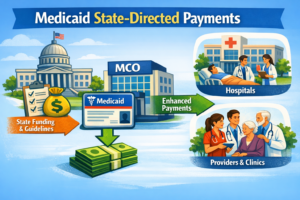 CMS has approved preprints for Medicaid state-directed payments for the following states:
- Florida – professional services rates
- Florida – professional services rates
- Indiana – inpatient and outpatient rates
- Indiana – payments for eligible physicians and non-physician practitioners
- Kansas – outpatient payments for selected hospitals
- Massachusetts – performance improvement initiative
- Massachusetts – inpatient and outpatient payments for selected hospitals
- Nebraska – inpatient and outpatient hospital payments
- New Hampshire – behavioral health outpatient services
- New Hampshire – durable medical equipment payments
- New Mexico – fees for eligible non-contract providers
- Ohio – inpatient and outpatient hospital payments
- Oregon – inpatient and outpatient payments for selected hospitals
- Rhode Island – section 1115 total cost of care demonstration payments
- Virginia – durable medical equipment payments
- Virginia – inpatient and outpatient hospital payments
- Washington – sexual and reproductive health family planning rates
- Wisconsin – professional services at an academic medical center
- Wisconsin – inpatient and outpatient hospital payments
 Health Policy Newsletters, Reports, and Videos
Drug Enforcement Administration (DEA)
 The DEA has issued a final rule to implement a portion of the Substance Use-Disorder Prevention that Promotes Opioid Recovery and Treatment for Patients and Communities Act of 2018 (the SUPPORT Act), which became law in 2018, amending the Controlled Substances Act, that expands the conditions practitioners must meet to provide medication-assisted treatment for opioid use disorder and expands the options available for physicians to be considered a qualifying physician. Learn more about the final rule from this formal notice. The rule’s provisions take effect on July 9.
Medicare Payment Advisory Commission (MedPAC)
MedPAC has submitted a comment letter in response to CMS’s proposed FY 2027 rule on the Medicare inpatient prospective payment system. In the letter, MedPAC supports CMS’s proposal to:
- implement the Comprehensive Care for Joint Replacement Expanded model
- repeal the alternative pathways for the inpatient prospective payment system’s new technology add-on payments and for the outpatient prospective payment system’s pass-through payment
See the MedPAC letter to CMS here.
Stakeholder Events
CMS – HIPAA Administrative Transactions Listening Session – July 1
CMS’s National Standards Group is conducting a listening session to solicit perspectives from the Designated Standards Maintenance Organizations and Workgroup for Electronic Data Interchange. During this three-hour session, to be held on Wednesday, July 1 at 1:00 (eastern), CMS will share information and provide feedback on a series of questions disseminated in advance regarding Version 8060 HIPAA Administrative Transactions. Go here to register to participate.
MedPAC – Commissioners Meeting – September 3-4
MedPAC’s commissioners will hold their next public meeting virtually on Thursday, September 3 and Friday, September 4. An agenda for the meeting and information about how to participate has not yet been posted; when they are, they will be found here.
MACPAC – Commissioners Meeting – September 24-25
MACPAC’s commissioners will hold their next public meeting on Thursday, September 24 and Friday, September 25. An agenda for the meeting and information about how to participate has not yet been posted; when they are, they will be found here.

The following is the latest health policy news from the federal government for June 5-11. Some of the language used below is taken directly from government documents.
Don’t Miss:
For more information:
A federal court has rejected the $100,000 application fee set by the Department of Homeland Security and State Department for employers seeking H-1B visas to bring foreign workers to the U.S. to work in specialized roles. In a challenge brought by 20 state governments, the court concluded that the fee constituted a tax and ruled that only Congress, not the executive branch, can levy taxes. H-1B visas are often sought by hospitals, health systems, and other health care organizations to recruit foreign doctors and other skilled health care professionals to the U.S. to help overcome domestic labor shortages. Learn more from the court’s decision in the case.
Centers for Medicare & Medicaid Services (CMS)
Department of Health and Human Services (HHS)
HHS/Office of the Inspector General
Medicaid State Plan Amendments
CMS has approved state plan amendments for Medicaid and CHIP programs in the following states:
State-Directed Medicaid Payments
Drug Enforcement Administration (DEA)
Medicare Payment Advisory Commission (MedPAC)
MedPAC has submitted a comment letter in response to CMS’s proposed FY 2027 rule on the Medicare inpatient prospective payment system. In the letter, MedPAC supports CMS’s proposal to:
See the MedPAC letter to CMS here.
Stakeholder Events
CMS – HIPAA Administrative Transactions Listening Session – July 1
CMS’s National Standards Group is conducting a listening session to solicit perspectives from the Designated Standards Maintenance Organizations and Workgroup for Electronic Data Interchange. During this three-hour session, to be held on Wednesday, July 1 at 1:00 (eastern), CMS will share information and provide feedback on a series of questions disseminated in advance regarding Version 8060 HIPAA Administrative Transactions. Go here to register to participate.
MedPAC – Commissioners Meeting – September 3-4
MedPAC’s commissioners will hold their next public meeting virtually on Thursday, September 3 and Friday, September 4. An agenda for the meeting and information about how to participate has not yet been posted; when they are, they will be found here.
MACPAC – Commissioners Meeting – September 24-25
MACPAC’s commissioners will hold their next public meeting on Thursday, September 24 and Friday, September 25. An agenda for the meeting and information about how to participate has not yet been posted; when they are, they will be found here.
Categories
Recent Posts
Archives