
Don’t miss:
- CMS publishes new Medicaid work/community engagement requirements
- Energy and Commerce Committee looks at price transparency in health care
- An AI executive order and Congress prepares to weigh in
- Price cut: IDR dispute fee to fall from $115 to $15 per dispute
The following is the latest health policy news from the federal government for May 29 to June 4. Some of the language used below is taken directly from government documents.
 Medicaid Work Requirements – Interim Final Rule
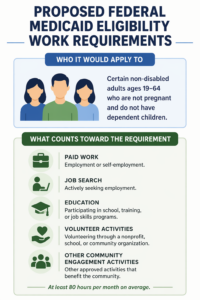
CMS has published an interim final rule with comment period to implement the Medicaid work and community engagement requirements mandated by H.R. 1. The rule, which applies primarily to individuals seeking to enroll in Medicaid through the Affordable Care Act’s Medicaid expansion that has been adopted in 40 states and the District of Columbia, defines work and community engagement requirements for adults to gain or maintain Medicaid eligibility for applications on or after January 1, 2027.
The rule defines specific conditions that may exempt some adults from the requirement of 80 hours a month of work or community engagement, including:
- parents and caretaker relatives of a dependent child
- disabled individuals and their caretaker relatives
- veterans with disability rated as total
- individuals who are found to be medically frail, which requires that an individual’s condition prevents them from working or engaging in community engagement activities
States may offer short-term exceptions, including for:
- hospitalization or medical treatment
- travel for specialized care
- high-unemployment areas
- federally declared disasters/emergencies
Under this interim final rule, states must:
- identify who is subject to or exempt from the work requirements
- verify compliance at application and renewal
- conduct outreach to affected populations
- manage noncompliance workflows
- submit data to CMS for oversight
The comment period for the rule ends on July 31. Learn more from this CMS news release; an accompanying CMS fact sheet; the formal notice; and an analysis from HHS’s Office of the Assistant Secretary for Planning and Evaluation titled “Medicaid Work Requirements Incentivize Employment and Are Estimated to Reduce Poverty.”
 Congress
- The House Energy and Commerce Committee’s Health Subcommittee has announced a hearing for June 10, titled “Lowering Health Care Costs for All Americans: Examining Policies to Increase Health Care Transparency,” to discuss nine bills. The proposed bills would require:
-
- more price transparency from hospitals;
- published overhead costs, claim payments, and claim denial rates from health insurers;
- increased reporting about health care-related ownership; and
- more transparency from Medicare Advantage plans.
Go here for details about the hearing, including links to the legislation under consideration.
- House Republican leaders seek to define the outlines of a third party-line reconciliation bill in the coming weeks, hoping to pass “affordability” legislation before the August recess. CMS is encouraging House Republicans to focus on fraud, waste, and abuse in federal health care programs.
- The Senate is expected to pass this Congress’s second reconciliation bill to fund ICE and Border Protection later today. If so, the House may vote on the bill tomorrow.
 The White House
- The White House has issued an executive order calling for the realignment of U.S. core childhood vaccine recommendations with best practices from peer, developed countries. Learn more from this executive order and an accompanying fact sheet.
- The White House has issued an executive order promoting advanced artificial intelligence innovation and security, seeking to “… to promote AI innovation and security by working collaboratively with the private sector to modernize government and private sector information systems and harden them against external threats; to protect American ingenuity and intellectual property from exploitation and theft by adversaries; and to cultivate America’s advanced AI-enabled capabilities.” Learn more from the executive order and this White House fact sheet.
Proposed “Regulation for Federal Financial Assistance”
The Office of Management and Budget (OMB) has proposed a ”Regulation for Federal Financial Assistance” that would significantly alter how most federal agencies, including HHS, award discretionary grants, enter into cooperative agreements, and provide other forms of assistance. It would not apply to mandatory spending programs such as Medicare and Medicaid.
Among other changes, the regulation would require all potential grant awards to be reviewed by political appointees at OMB and would reduce the impact of peer review for research grants; ban grants that involve diversity, equity, and inclusion policies, “gender ideology,” or child gender transitions; reject funding for disparate-impact research; limit access to funding for projects involving non-American participants from some foreign countries; eliminate fixed-amount awards; authorize funding agencies to terminate grants with no right to review or appeal; and include a review of the organizational practices of applicants’ institutional affiliations.
Learn more from the proposed rule. The deadline for stakeholders to submit comments is July 13.
 Centers for Medicare & Medicaid Services (CMS)
- For federal Independent Dispute Resolution disputes initiated on or after June 11, 2026, the administrative fee will be $15 per party per dispute. The fee for disputes initiated on or after January 22, 2024 but before June 11, 2026 remains $115 per party per dispute. Find CMS’s notice about the fee decrease here.
- CMS has posted new compliance enforcement actions against 15 Medicare Part C and Part D plans. The enforcement actions include civil money penalties, suspension of enrollment, and mandated corrective actions. Go here to learn more.
- CMS has issued a final rule updating and revising its Increasing Organ Transplant Access (IOTA) Model, a six-year year mandatory alternative payment model. Among other changes, the final rule revises the criteria for kidney center participation in the program, refines the assessment of participant performance, and modifies certain Medicare payment policies. Learn more from this final rule, which takes effect on July 1.
- CMS has posted required and voluntary eCQM updates for the CY 2026 hospital outpatient quality reporting period. Learn more from this notice.
- CMS is introducing the Emergency Care Access and Timeliness eCQM for the hospital outpatient quality reporting program. This measure will support the assessment of emergency department access, patient flow, and timeliness of care. Learn more from this CMS notice.
- CMS has added the following items to its Quality Payment Program resource library. (Note: clicking these links may give a prompt to download a file that may be a zip file.)
 Department of Health and Human Services
- President Trump has nominated Ge Bai, PhD, CPA, to be an Assistant Secretary of the Department of Health and Human Services. Bei is a professor of accounting at the Johns Hopkins Carey Business School and professor of health policy and management at the Johns Hopkins Bloomberg School of Public Health. She previously served as a visiting scholar in the Congressional Budget Office’s Health Analysis Division and since earlier this year has worked as Principal Deputy Assistant Secretary for Planning and Evaluation at HHS. Some of Dr. Bei’s recent publications focus on urban hospitals that reclassified as rural for Medicare purposes; hospital price transparency; and measures of community benefit by non-profit hospitals.
- A federal court has struck down a 2024 HHS rule titled “Nondiscrimination in Health Programs and Activities” that extended federal anti-discrimination protections to transgender health care. In the case of Tennessee v. Kennedy, the court ruled that HHS exceeded its authority by redefining “sex discrimination” under the Affordable Care Act to include gender identity, with the court concluding that “sex,” in the 1972 enabling legislation, referred to biological sex. Following the ruling, HHS and CMS issued a notice formally announcing that they will not enforce the vacated provisions of the regulation. Learn more from the court’s ruling in the case and from the HHS notice of non-enforcement.
- HHS’s Office of the Inspector General (OIG) has found that CMS potentially overpaid Medicare Advantage organizations $462 million based on unsupported acute stroke diagnosis codes. Learn about the problems the OIG found and the recommendations it made to correct them from this OIG report.
- HHS has announced a series of initiatives to strengthen the nation’s response to Lyme disease and other tick-borne illnesses. These steps include a multi-million-dollar pilot program focused on tick control; up to $2.5 million in innovation challenges; funding for NIH researchers; and a public-private collaboration to help patients connect with experienced providers. Learn more from this HHS news release.
 HHS Newsletters, Reports, and Videos
- CMS – MLN Connects – May 28
- CDC – Morbidity and Mortality Weekly Report (MMWR) – June 4
- HHS/Health Resources and Services Administration (HRSA) – HRSA eNews – May 2026
- HHS Office of the Inspector General – weekly “This Week With HHS-OIG” video – May 29
- Organ Procurement and Transplantation Network (OPTN) – May 2026 Modernization Update
- OPTN – May 13 OPTN town hall meeting – video
 Centers for Disease Control and Prevention (CDC)
- As of the end of May, the CDC has confirmed 1,983 cases of measles in 40 jurisdictions and 30 new outbreaks for 2026. Learn more about measles cases and find resources for identifying, treating, and communicating about measles from the CDC’s updated Measles Cases and Outbreaks web page.
- Last week the CDC held a webinar for clinicians to help them prepare for, diagnose, and manage patients with suspect or confirmed Ebola disease and how to prevent Ebola from spreading. Now, the agency has posted a video of that webinar, a transcript, and the slides presented during the event. To find them go here and scroll down.
- The CDC has suspended the introduction of certain people from countries where an outbreak of Ebola exists for a period of 30 days. The order took effect on May 22 and extends until June 22. Find the CDC order here.
 Stakeholder Events
CMS – HCPCS Level II Public Meetings – June 1
CMS will hold its 2026 HCPCS level II public meeting, in person and virtually, on June 1, 2026 at 9:00 (eastern), with an overflow date of Tuesday, June 2, 2026 to be held virtually, if necessary, to discuss CMS’s preliminary coding, Medicare benefit category, and Medicare payment determinations. Learn more about the meeting, including how to submit questions and comments and how to register to participate, from this CMS notice.
CMS – HIPAA Administrative Transactions Listening Session – July 1
CMS’ National Standards Group is conducting a listening session to solicit perspectives from the Designated Standards Maintenance Organizations and Workgroup for Electronic Data Interchange. During this three-hour session, to be held on Wednesday, July 1 at 1:00 (eastern), CMS will share information and provide feedback on a series of questions disseminated in advance regarding Version 8060 HIPAA Administrative Transactions. Go here to register to participate.
MedPAC – Commissioners Meeting – September 3-4
MedPAC’s commissioners will hold their next public meeting virtually on Thursday, September 3 and Friday, September 4. An agenda for the meeting and information about how to participate has not yet been posted; when they are, they will be found here.
MACPAC – Commissioners Meeting – September 24-25
MACPAC’s commissioners will hold their next public meeting on Thursday, September 24 and Friday, September 25. An agenda for the meeting and information about how to participate has not yet been posted; when they are, they will be found here.