
Don’t Miss:
- 340B Rebate Model pilot program – next steps
- Stricter rules on CMS’s reviews of new and existing section 1115 Medicaid demonstration programs
- Changes in health care institution accrediting practices
- HHS posts mental and behavioral health grant opportunities
The following is the latest health policy news from the federal government for June 12-18. Some of the language used below is taken directly from government documents.
 Congress
- Both chambers of Congress will return to session on June 22.
- The House Energy and Commerce Committee’s Oversight and Investigations Subcommittee will hold a hearing titled “State Medicaid Program Integrity: Examining Fraud Risks and Oversight Deficiencies” on Thursday, June 25. For more information, see the press release here.
- Key committees continue to work on health care legislation that could be included in either a third reconciliation bill before the end of July or in an FY 2027 spending bill.
340B
 HRSA has posted a notice announcing that it intends to introduce a revised 340B Rebate Model pilot program as a mechanism for qualifying drug manufacturers that wish “… to participate to effectuate a 340B ceiling price on a limited set of drugs sold to covered 340B entities using rebates…,” as distinguished from the upfront discount model the 340B program currently employs. The agency posted an information collection request in February of this year and received numerous comments from hospitals, health systems, community health centers, pharmacies, manufacturers, vendors, national associations, and others. Now, based in part on that feedback, it has posted a new information request informing 340B stakeholders of criteria and standards for implementation of its revised 340B Rebate pilot program. This request primarily addresses the administrative burden that covered entities anticipate if they are required to submit the mandatory data to drug manufacturers. HRSA views the comments it received about the impact its first proposed 340B Rebate Model pilot program might have on providers’ operations and finances and 340B-eligible patients as not relevant to the data collection and burden issue and does not address those concerns in this information request, writing that it will address those matters separately. Learn more about this information request, including the feedback HRSA received in response to its original publication of such a notice in February, from this formal HRSA notice. The deadline for stakeholders to submit comments is July 15.
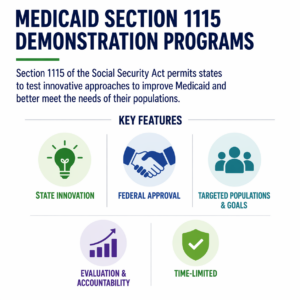 CMS: Proposed Changes in Review of Section 1115 Medicaid Demonstration Programs
CMS has sent a memo to state Medicaid directors describing upcoming changes in how it will review new Medicaid section 1115 demonstration project proposals and the proposed renewal and amendment of existing section 1115 projects. CMS explains that it will introduce a new policy that the CMS Chief Actuary must certify that section 1115 demonstration projects will not increase federal Medicaid expenditures compared to what those expenditures would have been without the demonstration. The new approach, mandated under last year’s H.R. 1, the federal budget reconciliation law, replaces the current retrospective budget neutrality test with a prospective, actuarially-based certification process, requiring states to provide more detailed analyses and documentation for demonstration activities and limiting the use of savings rollovers and previously deemed budget-neutral authorities. CMS intends to propose a new rule formalizing this guidance but will begin implementing this guidance on January 1, 2027 for newly proposed demonstrations, demonstration renewals, and demonstration amendments. Learn more from this CMS news release and the CMS memo to state Medicaid directors.
 Centers for Medicare & Medicaid Services (CMS)
- CMS has issued a final rule (with comment period) that seeks to strengthen oversight of health care accrediting organizations. The rule requires that accrediting organization standards and survey practices align with Medicare requirements and state survey agency processes. It establishes a new CMS system for monitoring accrediting organization performance; standardizes definitions and validation procedures; requires accrediting organization surveyors to complete the same CMS training as state surveyors; and streamlines CMS oversight. It also bars accrediting organizations from conducting certain mock surveys for providers they accredit as part of an effort to prevent conflicts of interest and protect survey integrity. Learn more from this CMS news release, a CMS fact sheet, and the final rule. The deadline for submitting comments is August 17 and the rule takes effect on June 16, 2027.
- CMS has proposed a new rule codifying a permanent framework for the Medicare Drug Price Negotiation Program. In the future, CMS would select up to 20 additional drugs for negotiations. Learn more from this CMS news release; an accompanying CMS fact sheet; and the proposed rule itself. The deadline for interested parties to submit comments is August 17.
- CMS has issued a request for information seeking input to support its review of the Essential Health Benefits (EHB) framework established under the Affordable Care Act. CMS seeks comments on current interpretations of EHBs, methodologies used to determine the scope of benefits included as EHBs, and more. CMS intends to use this information to decide whether to revise current EHB regulations. Learn more from this formal notice. The deadline for submitting comments is July 15.
- CMS has issued a request for information soliciting technical input on the services and business practices of pharmacy benefit managers (PBMs) and their affiliates to inform implementation of recent legislation. It specifically focuses on gathering information to inform two specific legislative requirements that are effective beginning calendar year 2028: data reporting requirements and restrictions on the remuneration that PBMs and their affiliates may receive for services in connection with the utilization of covered Part D drugs. Learn more about the request for information and what CMS seeks from this notice. The deadline for submitting comments is July 20.
- CMS has added the following items to its Quality Payment Program resource library. (Note: clicking these links may give a prompt to download a file that may be a zip file.)
 Department of Health and Human Services (HHS)
- HHS has announced the availability of $96 million in grant funding opportunities through its Safety Through Recovery, Engagement, and Evidence-based Treatment and Support (STREETS) program and another $612 million in grants for additional behavioral health programs. Learn more about the 25 separate programs through which grants will be awarded and find links to additional information about those programs and the formal funding notices in this HHS news release. Please note that the deadlines for applying for some of these grants is as soon as one month from now.
- HHS’s Substance Abuse and Mental Health Services Administration (SAMHSA) has announced $40 million in funding opportunities for eight grant programs that seek to prevent addiction, strengthen the behavioral health workforce, and support efforts to address mental illness and prevent suicide. Learn more about the individual programs and find links to their funding opportunity notices from this HHS news release. Please note that the deadlines for applying for funding under these programs range from one week to one month from now.
- HHS and its Office of Disease Prevention and Health Promotion are soliciting comments from the public on new objectives to be added to “Healthy People 2030” and to gather input to refine or expand existing screen time objectives for young people of different ages. Learn more about the new objectives HHS proposes adding and about the information it seeks about screen time from this HHS notice. Learn more about Healthy People 2030 from the program’s web site. The deadline for submitting comments is July 16.
 HHS/Office of the Inspector General
- HHS’s Office of the Inspector General (OIG) has published two reports presenting its findings from audits examining Medicaid managed care participants’ access to maternal health care services and presenting its recommendations for addressing the problems it encountered. Those reports are:
- HHS’s OIG is required by statute to identify and inform CMS about billing codes for which both covered physician-administered versions and non-covered self-administered versions of a drug are used to set Medicare Part B payment amounts. In a new review, OIG examined Part B payment files over a five-quarter period to identify any billing codes that included covered and non-covered versions and whether CMS included the average sales prices for non-covered versions when calculating payment amounts for January 2025-March 2026. Find the OIG report here.
- CMS’s processes were not effective in ensuring the accuracy of staffing information reported in nursing homes’ payroll-based journals, the OIG concluded after a recent audit. Learn more about what the OIG found and what it recommends to address those problems from this OIG report.
- The OIG has issued a favorable opinion regarding a program operated by a pharmaceutical manufacturer to sponsor antibody testing for eligible patients to determine whether it may be appropriate to prescribe a certain drug manufactured by the pharmaceutical manufacturer. Find that advisory opinion here.
- The OIG has updated its work plan for new audits and evaluations. Find the latest additions to the work plan here.
 Medicaid State Plan Amendments
CMS has approved state plan amendments for Medicaid and CHIP programs in the following states:
- Arizona – GME payments for new and expanded programs
- Arizona – GME and IME payments
- Arkansas – vaccine administration payments
- Colorado – authority to submit state plan amendments
- Connecticut – income standards for optional state supplement program
- Hawaii – Medicaid eligibility
- Illinois – service limitations for patients in Institutions for Mental Diseases
- Iowa – diagnostic and preventive dental rates
- Kentucky – methodology for developing PACE rates
- Maine – methodology for qualifying for shared savings payments
- Maine – supplemental payments for former critical access hospitals
- Maryland – targeted case management services
- Massachusetts – payments for personal care attendants
- Michigan – pharmacist services
- Minnesota – freestanding birth center payments
- Montana – targeted case management services
- Nevada – DMEPOS payments
- New York – payments for public residential health care facilities
- New York – nursing home payments
- Texas – provider fee schedules
- Wisconsin – prior authorization for physical therapy
- Wisconsin – inpatient and outpatient hospital access payments
- Wyoming – home equity limit for long-term-care services
 Health Policy Newsletters, Reports, and Videos
- CMS – MLN Connects – June 18
- CMS – ACCESS Model Primary Care Practitioner and Referring Clinician Webinar – video of a webinar to support primary care practitioners and referring clinicians as they consider engagement with the model – June 4 video
- CMS – Part D Modernization Model – Final Evaluation Report – June 2026 – executive summary and full report
- CMS – Community Health Access and Rural Transformation (CHART) Model – Final Evaluation Report – executive summary and full report
- HHS/Health Resources and Services Administration (HRSA) – HRSA eNews – June 12 (includes funding opportunities)
- HRSA – Office for the Advancement of Telehealth – announcements, June 15 and June 17 (including funding opportunities)
- HHS – “This Week at HHS/OIG” – video – June 12
- CDC – Morbidity and Mortality Weekly Report (MMWR)
- “Legionnaires Disease Associated with a Private-Use Hot Tub in a Vacation Rental Property – New York, October 2024-April 2025”
- “Alcohol Consumption During Pregnancy Among Women Aged 18-49 Years – United States, 2021-2024”
- “Foodborne Disease Outbreaks Associated with Marine Toxins – Foodborne Disease Outbreak Surveillance System, United States, 2011-2023”
 Centers for Disease Control and Prevention (CDC)
- The CDC has activated a Level 3 emergency response to New World screwworm and is supporting the Department of Agriculture (USDA) and the Texas Department State Health Services to address the recent animal infestations in southern Texas and New Mexico. For more information, see this USDA dashboard showing where animal cases have been identified and the CDC press release here.
- The CDC issued a food safety alert in response to a multistate outbreak of infant botulism linked to infant formulas. All three infants sickened by botulism have been hospitalized and treated; no deaths have been reported. For more information see this CDC news release.
Medicare Payment Advisory Commission (MedPAC)
MedPAC has released its June 2026 Report to the Congress: Medicare and the Health Care Delivery System. As mandated by Congress, MedPAC reports annually on improvements to Medicare payment systems, issues affecting the Medicare program, and changes to health care delivery and the market for health care services. This year’s report examines how Medicare payment incentives affect spending and care delivery; explores challenges beneficiaries face when making Medicare enrollment decisions; examines Medicare payment operations and their role in identifying improper payments; analyzes the association between Medicare Advantage enrollment and provider finances; evaluates access to certain palliative services under the hospice benefit; and recommends continuing and streamlining Medicare’s Ground Ambulance Data Collection System. Learn more from this MedPAC news release, which summarizes the report, and the complete report.
 Medicaid and CHIP Payment and Access Commission (MACPAC)
- MACPAC has submitted a comment letter in response to CMS’s proposed FY 2027 rule on interoperability standards and prior authorization for prescription drugs. In the letter, MACPAC supports CMS’s proposal to:
- improve transparency on the prior authorization process and report data on the volume and outcomes of prior authorization decisions
- improve outcomes of appeals of prior authorization decisions for both drugs and non-drug items and services
Specifically, MACPAC asks CMS to consider reporting this data at a more granular level to better monitor prior authorization outcomes for specific populations and services. The letter also includes technical considerations regarding prior authorization decision timelines for drugs that are provided as part of, or incident to and in the same setting as, certain non-drug items and services. Find MACPAC letter to CMS here.
- The Medicaid and CHIP Payment and Access Commission (MACPAC) released its June 2026 Report to Congress on Medicaid and CHIP. Report to Congress on Medicaid and CHIP includes recommendations on community engagement requirements in Medicaid; automation in prior authorization; Medicaid managed care accountability; appropriate access to residential treatment services for Medicaid-enrolled youth; transitions to adult Medicaid coverage for children and youth with special health care needs; and the Program of All-Inclusive Care for the Elderly (PACE). It also includes a chapter on provider enrollment in Medicaid. Learn more from this MACPAC news release, which summarizes the report, and the complete report.
Congressional Budget Office (CBO)
The CBO has issued a call for new research on the No Surprises Act. When the law was passed, the CBO estimated that it would reduce the in- and out-of-network prices that insurers pay to providers that had high rates of surprise billing before the law was enacted and that those lower prices would, in turn, reduce the premiums that insurers charge for commercial plans by roughly one percent. Emerging evidence, however, suggests that the law might not have the effects CBO anticipated because although prices for some services that had high rates of surprise billing before the law’s enactment have declined, several published reports indicate that providers are winning more than eight in ten Independent Dispute Resolution cases and are being awarded payments that are much higher than expected, particularly in certain geographic areas. The CBO is therefore seeking research that evaluates the law’s effects on health care prices and network participation. Learn more from this CBO blog post.
 Stakeholder Events
CMS – PEPPER Updates for Critical Access and Short-Term Hospitals Webinar – June 23
CMS will hold a webinar to review the FY 2025 Critical Access Hospital Program for Evaluating Payment Patterns Electronic Report (PEPPER),released last month and the Q1 FY 2026 short-term acute-care hospital PEPPER, released earlier this month, on Tuesday, June 23 at 1:00 (eastern). The session will review the new reports and offer participants guidance on navigating recent changes. Go here to register to participate and for information about how to submit questions beforehand.
CMS – HIPAA Administrative Transactions Listening Session – July 1
CMS’s National Standards Group is conducting a listening session to solicit perspectives from the Designated Standards Maintenance Organizations and Workgroup for Electronic Data Interchange. During this three-hour session, to be held on Wednesday, July 1 at 1:00 (eastern), CMS will share information and provide feedback on a series of questions disseminated in advance regarding Version 8060 HIPAA Administrative Transactions. Go here to register to participate.
CMS – 2026 National Provider Compliance Conference – August 11–12
On Tuesday, August 11 and Wednesday, August 12, CMS will hold a national provider compliance conference that will bring together Medicare Administrative Contractors (MACs) and Center for Program Integrity experts to provide compliance professionals with the information and tools they need to submit Medicare Part A, Part B, home health and hospice, and durable medical equipment claims. Learning opportunities will include individual presentations, Q&A segments, panel discussions, and a dedicated exhibit area for engagement between MACs and providers. The target audience for this conference is Medicare fee-for-service providers only, including medical review contractors, compliance officers, nurse and billing managers, medical record staff, coders, and provider community associations. Go here to learn more about the conference and to register to participate. The conference will be held in Charlotte and will have no virtual component and a limited number of participants.
MedPAC – Commissioners Meeting – September 3-4
MedPAC’s commissioners will hold their next public meeting virtually on Thursday, September 3 and Friday, September 4. An agenda for the meeting and information about how to participate has not yet been posted; when they are, they will be found here.
MACPAC – Commissioners Meeting – September 24-25
MACPAC’s commissioners will hold their next public meeting on Thursday, September 24 and Friday, September 25. An agenda for the meeting and information about how to participate has not yet been posted; when they are, they will be found here.