
Don’t Miss:
- States may delay implementing new Medicaid work requirement
- New CMS proposal to “CRUSH” waste, fraud, and abuse
- HHS updates HIPAA
- IDR Gateway opens
The following is the latest health policy news from the federal government for November 13-19. Some of the language used below is taken directly from government documents.
 Congress
- Federal government funding is set to expire on December 11 and lawmakers face a tight deadline to avert a shutdown. Appropriators have discussed another short-term continuing resolution (CR), although the length of an extension remains unclear. Both the House and Senate appropriations committees have released all 12 spending bills, leaving open the possibility of advancing some FY 2027 appropriations through a minibus package.
In this lame-duck session, House Republicans have discussed a potential third reconciliation package to address remaining priorities, including defense funding; at this time Senate Republicans do not believe they have the votes to advance another party-line bill. Key health care committees are considering a potential bipartisan health care package, which could include Medicare physician payment changes, health care cost transparency legislation, a delay of the 340B Rebate Model Pilot Program, and some post-acute care provisions.
- Senate Democrats are pressing CMS for answers over its withholding of Medicaid funding from states, with Senate Finance Committee ranking member Ron Wyden (D-OR) leading a letter to CMS Administrator Mehmet Oz seeking information on the administration’s actions affecting state Medicaid programs, especially the withholding of federal Medicaid funds. For more information, see the letter here and the press release here.
- Prior authorization reform faces congressional scrutiny as Senate Democrats seek answers from six major health insurers. Senators Jon Ossoff (D-GA), Sheldon Whitehouse (D-RI), and Ron Wyden (D-OR) sent separate letters to Aetna, Blue Cross Blue Shield, Cigna, Elevance Health, Humana, and UnitedHealthcare requesting updates on steps they have taken to reduce prior authorization burdens and increase transparency. The insurers participated in a June 2025 CMS roundtable during which they committed to streamlining and improving prior authorization processes across Medicare Advantage, Medicaid managed care, and Health Insurance Marketplace and commercial plans. The senators seek responses by December 4. For more information, including links to all six letters, see the press release here.
- House Democrats have nominated minority leader Hakeem Jeffries (D-NY) for Speaker of the House in an uncontested 251-11 vote. The full House will vote to elect the Speaker on January 3, 2027, at the start of the 120th Congress. In other Democratic leadership votes, Katherine Clark (D-MA) was elected majority leader, Pete Aguilar (D-CA) as majority whip, Joe Neguse (D-CO) as assistant speaker, Ted Lieu (D-CA) as House Democratic Caucus chair, and Lauren Underwood (D-IL) as vice chair of the House Democratic Caucus.
 New Medicaid Work Requirements and Eligibility Criteria
- CMS offers optional six-month delay of new Medicaid work/community engagement requirements. The agency has offered states an additional six months to implement new Medicaid eligibility criteria that include a new work/community engagement requirement. States that participate in this hold-harmless period will still assess whether individuals meet the new Medicaid work and community engagement requirements but may not deny applications or disenroll otherwise eligible individuals during this period. CMS is encouraging states to use this additional time to maximize automated verification; make their processes clearer to navigate; test and strengthen end-to-end processes; and work with community partners to help Medicaid applicants and beneficiaries find opportunities for employment, education, job training, and volunteering. The new Medicaid community eligibility criteria were mandated under the FY 2025 budget reconciliation bill and were to take effect on January 1, 2027. Learn more from this CMS news release and this memo from CMS to the states. The states have until December 11 to notify CMS whether they will take advantage of this hold-harmless period.
- CMS proposes system for verifying college enrollment to facilitate determining Medicaid and ACA eligibility. Under this proposal, CMS and the Department of Education would establish a data-sharing program to verify college enrollment as an automated means of determining whether individuals meet the community engagement criteria for Medicaid and Affordable Care Act tax credit eligibility established under the FY 2025 budget reconciliation act that take effect on January 1. Learn more about the program from this formal CMS notice. The deadline for submitting comments is December 16.
- CMS advises states on Medicaid eligibility and enrollment changes. CMS has sent an informational bulletin to the states addressing the implementation of Medicaid and CHIP eligibility and enrollment changes included in the FY 2025 budget reconciliation law. Most of the memo consists of a lengthy slide deck titled “‘Working Families Tax Cut’ Legislation, Public Law 119-21: Summary of Medicaid and CHIP Enrollment-Related Provisions.” Find the memo and the slide deck here.
 CMS Advances New Health Care “CRUSH” Rule
CMS proposes new measures to identify waste, fraud, and abuse. A new “Comprehensive Regulations to Uncover Suspicious Healthcare (CRUSH)” proposed rule calls for new efforts to identify and address health care waste, fraud, and abuse. The rule proposes changes to strengthen program integrity by enhancing provider screening and enrollment safeguards, requiring prompt self-reporting and return of identified fee-for-service overpayments, improving managed care program integrity reporting, increasing provider ownership transparency and data reporting for oversight agencies, and intensifying scrutiny of deductions from Medicaid payments. The agency projects that the proposed rule’s implementation could save nearly $90 billion over the next ten years.
Major Medicare Advantage provisions in the proposed rule include requiring Medicare Advantage and Part D plans to report all suspicious or substantiated fraud, waste, and abuse; giving CMS greater authority to deny or revoke Medicare enrollment for providers and suppliers; requiring providers to report all changes to enrollment information within 30 calendar days; requiring certain Medicare Advantage plan providers and suppliers to enroll in Original Medicare, thereby enabling CMS to verify their credentials and screen for risks; strengthening Medicare Advantage risk adjustment data validation audits; and strengthening protections for seniors against unsolicited texts, social media messages, emails without an opt-out, and door-to-door visits from medical supply companies and their agents.
Major Medicaid/CHIP fraud prevention provisions include permitting states to determine that a credible allegation of fraud exists based on a determination made by CMS or another federal agency; expanding state fraud and abuse reporting; requiring states to collect and use NPIs for all eligible Medicaid and CHIP providers; strengthening beneficiary eligibility oversight and the recovery of overpayments; and adding grounds to deny or terminate Medicaid/CHIP provider enrollment while expanding disclosure requirements for owning and managing parties.
The proposed rule also includes measures that seek to strengthen CMS’s ability to protect consumers from unauthorized enrollments and coverage changes and restrict marketplace access for agents, brokers, and web brokers.
Learn more about the proposed CRUSH rule from this CMS news release; a CMS fact sheet that goes into greater detail about what CMS proposes and the tools it envisions using to support the program’s implementation; and the proposed rule itself. The deadline for submitting comments is January 19.
HHS Updates HIPAA Privacy Rule
 A long-awaited update of HIPAA regulations addresses privacy protections and rights for consumers, clarifies responsibilities for providers, and reduces administrative burden. The update, issued as a final rule by HHS’s Office for Civil Rights, seeks to strengthen the individual right of access by reducing the amount of time entities have to respond to individuals’ requests for copies of their private health information; amending fees for responding to record requests; authorizing individuals to direct a covered entity to transmit electronic health information to an authorized individual; and reducing the burden of identity verification to exercise access rights.
The final rule clarifies that health plans may use and disclose private health information for care coordination and case management. It also includes measures that seek to reduce regulatory burdens.
Learn more about the updated HIPAA rule from this HHS news release and the final rule itself. The rule takes effect on January 19.
 Centers for Medicare & Medicaid Services (CMS)
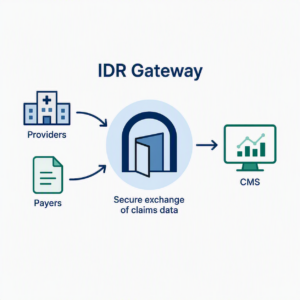
- The IDR Gateway is now open. Organizations with Independent Dispute Resolution (IDR) Gateway accounts can submit “Notice of IDR Initiation,” “Notice of IDR Initiation Response,” “Notice of Certified IDR Entity Selection,” and “Notice of Offer” web forms within the IDR Gateway. IDR Gateway users also can view reports and dispute records for No Surprises Act-covered billing disputes between providers and payers started within the IDR Gateway and disputes started outside the IDR Gateway that were successfully mapped to an organization using the dispute mapping process. Learn more about the IDR Gateway and the phased transition to its use from this CMS notice (and scroll down to “November 13, 2026 – Dispute Processing is Available in the IDR Gateway”).
- CMS releases 2027 Medicare Part A and Part B premiums, deductibles, and coinsurance and Medicare Part D income-related monthly adjustment amounts. The Medicare Part A inpatient hospital deductible will be $1776 in 2027. Beneficiaries will be required to pay a coinsurance of $444 a day for the 61st through 90th day of a hospitalization in a benefit period and $888 per day for lifetime reserve days. For beneficiaries in skilled nursing facilities, the daily coinsurance for days 21 through 100 of extended care services in a benefit period will be $222. The standard monthly premium for Medicare Part B will be $209.40, an increase of $6.50 over 2026. The annual deductible for all Medicare Part B beneficiaries will be $292 in 2027, an increase of $9 from 2026. Learn more about 2027 Medicare premiums, deductibles, and coinsurance, including Part B income-related monthly adjustments, Part B immuno-suppressive drug coverage, and Part D income-related monthly adjustments from this CMS fact sheet. Find CMS’s formal notice of 2027 Part A premiums here; its formal notice of 2027 inpatient hospital deductible and hospital and extended care services coinsurance amounts here; its formal notice of 2027 Part B monthly actuarial rates, premium rates, and annual deductibles here; and its formal notice of Part A premiums for the uninsured aged for certain disabled individuals who have exhausted other entitlements and who are not otherwise eligible for Medicare here.
- New hospital data added to Medicare Compare site. CMS has published its quarterly update of hospital data on the Medicare Compare web site. Learn more about the specific measures for which CMS has posted updated data and about new measures added to the site from this CMS notice.
- CMS updates ICD-10-CM coding course. CMS has updated its web-based training program for diagnosis coding using the ICD-10-CM. The program covers the new coding convention for punctuation and the updated code range for Chapter 7. Find the updated training course here.
- CMS updates ICD-10-PCS coding course. CMS also has updated its web-based training program for ICD-10-PCS procedure coding with updated coding examples for FY 2027. Find that program here.
- CMS posts 2027 home health rate changes. CMS has posted a bulletin describing the rate changes in its Medicare home health prospective payment system for 2027. Find that bulletin here. The changes it presents take effect on January 1.CMS posts 2027 ESRD changes. CMS has posted a bulletin describing the implementation of 2027 changes in its Medicare end-stage renal disease (ESRD) prospective payment system and payment for dialysis furnished for acute kidney injury in ESRD facilities. Find that bulletin here. The changes it presents take effect on January 1.
 CMS posts CJR-X checklist. CMS has posted a participant readiness checklist that presents key actions and resources to help participants in its Comprehensive Care for Joint Replacement Expanded (CJR-X) Model, which is a mandatory, nationwide Medicare bundled payment program that takes effect on January 1, 2028. Find that checklist here.
- CMS reports on Medicare Shared Savings Program performance. According to the agency, its Medicare Shared Savings Program saved more than $2.5 billion in 2025 while its participating accountable care organizations (ACOs) reached a record 12.6 million Medicare beneficiaries. ACO participants earned $4.9 billion in shared savings payments, with 80 percent of participating ACOs earning such payments. CMS also reports that all its participating ACOs met or exceeded Medicare’s quality reporting requirements. Learn more about the financial and quality performance of Medicare’s Shared Savings Program and its ACO participants in 2025 and the policy changes coming in 2027 from this CMS news release; an accompanying fact sheet; and another CMS fact sheet that describes those 2027 changes in greater detail.
- CMS reports on FY 2026 improper payments. CMS has issued a news release outlining the improper federal health care payments the agency identified in FY 2026. The agency reported improper payments for FY 2026, with comparisons to the same measures for FY 2025, for Original Medicare, Medicare Part C, Medicare Part D, Medicaid, CHIP, and the Advance Payments of the Premium Tax Credit program. In reporting these figures, the agency notes that “An improper payment is a payment that does not meet CMS program requirements. Improper payments include overpayments, underpayments, and payments for which there is insufficient information to determine whether payment requirements were met.” The agency also explains that “Improper payment rates do not measure fraud.” Learn more about the figures for each category and about the underlying factors that go into those figures from this CMS fact sheet.
- CMS has posted a “clinical super intelligence roadmap” for accelerating safe and reliable use of artificial intelligence (AI) in health care. This federal framework seeks to work in conjunction with innovators, states, and patient stakeholders to provide better answers to health care challenges, faster care, and lower costs. It recognizes the promise and risks of super intelligence, sets principles for trusted adoption, and lays out the government’s role in catalyzing innovation, protecting patient control, clarifying the rules of the road, and paying for outcomes that improve health and lower costs. Find the roadmap here.
- CMS provides guidance on electronic signatures. CMS has posted a paper prepared by the Workgroup for Electronic Data Interchange, an advisory committee to HHS and CMS, explaining the use of electronic signatures under CMS-0053-F, a final rule that introduced new federal standards for health care electronic signatures and claims attachments that applies to HIPAA-covered entities, health plans, and providers. Learn more about the rule from this CMS fact sheet from earlier this year, the final rule itself, and the Workgroup for Electronic Data Interchange paper “CMS-0053-F: What You Need to Know About Digital Signatures.” The rule took effect on May 26, 2026 and the deadline for compliance is May 26, 2028.
- CMS has added the following items to its Quality Payment Program resource library. (Note: clicking some of these links will download a zip file.)
 Department of Health and Human Services (HHS)
- HRSA proposes new data collection for its Rural Residency Planning and Development Program. HRSA has asked OMB for permission to introduce a new data collection instrument titled “Rural Residency Planning and Development Program Annual Performance Report.” The Rural Residency Planning and Development program seeks to improve and expand access to health care in rural areas by developing new sustainable rural residency programs. Under the program, HRSA provides start-up funding to grant recipients to create accredited rural residency programs in a qualifying medical specialty. This data collection will be an annual progress report for performance measurement and evaluation to demonstrate how funding addresses physician workforce shortages and challenges faced by rural communities. Prior data collection for this program was collected under Bureau of Health Workforce Performance Data Collection (OMB No. 0906-0086). Parties receiving program funds would be required to complete the data collection instrument. Learn more from this HRSA notice. The deadline for submitting comments is January 15.
- HRSA seeks change in Rural Maternity and Obstetrics Management Strategies Program Data collection. HHS’s Health Resources and Services Administration (HRSA) has asked OMB for permission to revise the current data collection instrument “Rural Maternity and Obstetrics Management Strategies Program Data Collection.” The proposed changes, which would affect participants in its Rural Maternity and Obstetrics Management Strategies Program, include changing the frequency of data reporting from annually biannually; changing from aggregate data reporting to patient-level data reporting; reducing the number of data elements; and removing some forms and reorganizing or relocating others. HRSA estimates an increase in the estimated total burden for participating organizations. Learn more from this notice of the proposed changes in the Rural Maternity and Obstetrics Management Strategies Program Data Collection. The deadline for submitting comments is December 16.
 Health Care Workforce
- Court vacates rule limiting foreign-born physician stays in the U.S. A federal court has vacated a Department of Homeland Security final rule that limited how much time foreign students could stay in the U.S. – a limit that affected roughly 17,000 physicians participating in fellowship and residency programs. The court vacated the Department of Homeland Security rule “…on the ground that it is arbitrary, capricious, an abuse of discretion, and otherwise not in accordance with law.” Learn more from the court’s ruling in the case.
- Department of Labor (DOL) proposes changes in rules governing health care jobs for non-citizens. The DOL proposes amending its regulations governing the certification of job opportunities offered by employers seeking to employ non-citizens for permanent positions in the U.S. DOL seeks to alter the standards by which it receives and reviews employers’ applications for permanent labor certification in ways it believes will protect the wages and job opportunities of U.S. workers. The proposed rule would eliminate Schedule A, which exempts certain jobs – including physical therapists and nurses – from the statutorily required labor market test. It also would ensure that employers seeking labor certification explore the broadest pool of U.S. workers; enhance safeguards for U.S. workers affected by layoffs, including those laid off by employers using third-party staffing companies; establish standards for employers to report layoffs; expand requirements for employers to provide U.S. workers with notice of applying for permanent labor certification; and improve employer compliance with program requirements and consideration of qualified U.S. workers that is comparable to job opportunities for which permanent labor certification is not required. Learn more from this Notice of Proposed Rulemaking and this DOL news release. The deadline for submitting comments is January 19.
- DOL reminds employers to provide accurate provider directories to workers. The DOL has issued an enforcement alert urging employers and plan fiduciaries to ensure that participants and beneficiaries receive accurate provider directories for in-network coverage under their health plans. According to the agency, health plans and insurance issuers are required under the Employee Retirement Income Security Act (ERISA) to regularly verify, update, and publish accurate provider directory information. The DOL enforcement alert provides best practices and questions to ask so that participants and beneficiaries are protected from unexpected out-of-network costs and receive quicker access to care from in-network providers. Learn more from this DOL news release and the enforcement alert.
Medicaid State Plan Amendments
 CMS has approved state plan amendments for Medicaid and CHIP programs for the following states:
- Colorado, classifying some non-emergency medical transportation expenditures as medical services and addressing how the state credentials drivers and vehicles
- Illinois, updating adaptive behavior support services reimbursement and coverage language
- Indiana, creating a limited benefit package to apply to eligible juveniles within 30 days before and 30 days after they are released from incarceration
- Maryland, implementing a one percent increase for the nursing facilities program
 Health Policy Newsletters, Reports, and Videos
- CMS – MLN Connects – November 19
- HHS/Office of the National Coordinator for Health Information Technology (ONC) – “The Road Ahead: The Trusted Exchange Framework and Common Agreement (TEFCA) 2026-2027 Workplan and New Monthly Metrics” – November 17 blog post
- HHS/ONC – TEFCA dashboard – November
- HHS – October meeting of the Advisory Council on Alzheimer’s Research, Care, and Services Meeting – video of the meeting, part 1 and part 2
- HHS – November 9 meeting of the Advisory Council on Parkinson’s Research, Care, and Services – four videos
- HHS/Office of the Inspector General (OIG) – “2026 Top Management & Performance Challenges Facing HHS” – November report
- HHS/Office of the Inspector General (OIG) – “This Week at OIG” – November 13 video
- HHS/Health Resources and Services Administration (HRSA)/Organ Procurement and Transplantation Network – November update
- Government Accountability Office (GAO) – “Medicare: HHS and CMS Should Better Manage Fraud Risks” – November 18 report
Food and Drug Administration (FDA)
The White House has withdrawn Heidi Overton’s nomination to lead the FDA and it is unclear whether it will have time to put forward another nominee before the end of the 119th Congress.
State of Measles in the U.S.
The Pan American Health Organization announced that the U.S. has lost its measles elimination status, ending a designation it received in 2000. Following the announcement, the CDC issued a statement encouraging use the measles, mumps, and rubella (MMR) vaccination and reaffirming its support to state, local, tribal, and territorial health departments in identifying at-risk communities, engaging partners, rapidly detecting cases, and responding to outbreaks. See the CDC’s statement here and Pan American Health Organization’s announcement here.
In response, House Energy and Commerce Committee ranking member Frank Pallone (D-NJ), Health Subcommittee ranking member Diana DeGette (D-CO), and Oversight and Investigations Subcommittee ranking member Yvette Clarke (D-NY) sent a letter to CDC Director Erica Schwartz raising concerns about how measles-related deaths are defined and reported. The lawmakers also announced plans to further expand their investigation into the agency’s response. For more information, see the letter here.
National Institutes of Health (NIH)
 NIH proposes updating 1998 Policy for Data and Safety Monitoring and seeks stakeholder input into its plans. The 1998 policy established NIH requirements for data and safety monitoring in clinical trials but the draft update calls for expanding the policy’s reach to all NIH-supported clinical research while using risk-based data and safety monitoring approaches to focus oversight where it is most needed and reduce administrative burden for research with lower risk. The NIH is proposing this update because clinical research and study designs have advanced significantly since 1998. Major aspects of the draft updated policy include expanding the scope of the 1998 policy from clinical trials to encompass all NIH-supported clinical research and clarifying the requirements that data and safety monitoring plans be based on the risk of the study and that NIH institutes, centers, and offices approve those plans. Now, the agency seeks stakeholder input on the changes it proposes. Learn more about those changes from this formal NIH notice and the draft policy. The deadline for submitting comments is January 6.
Congressional Budget Office (CBO)
The federal government could greatly increase its recovery of fraudulent Medicare spending by spending more on its Health Care Fraud and Abuse Control account, which is administered jointly by HHS and the Justice Department. Learn more from the CBO report “CBO’s Estimates of the Budgetary Effects of Increasing Funding for the Health Care Fraud and Abuse Control Account.”
Stakeholder Events
HHS/Office of the Assistant Secretary for Planning and Evaluation – ASPE Health Economics and Policy Forum – December 7
HHS’s Office of the Assistant Secretary for Planning and Evaluation (ASPE) will hold a Health Economics and Policy Forum on Monday, December 7 at 1:00 (eastern); the subject is rate-setting, hospital global budgets, and regulatory impact based on experiences in Maryland. Go here to find the session’s agenda and to register to participate.
 HHS/Office of the Assistant Secretary for Planning and Evaluation – Meeting of the Physician-Focused Payment Model Technical Advisory Committee – December 8
The Physician-Focused Payment Model Technical Advisory Committee of HHS’s Office of the Assistant Secretary for Planning and Evaluation (ASPE) will hold a public meeting on Tuesday, December 8 at 8:30 (eastern) to discuss and vote on the physician-focused payment model proposal “Episode Intelligence Authorization and Payment (EIA) Compensation Model (Revised Version).” Go here for information on how to register and participate and for the meeting’s agenda.
MedPAC – Commissioners Meeting – December 10-11
MedPAC’s commissioners will hold their next public meeting virtually on Thursday, December 10 and Friday, December 11. An agenda for the meeting has not yet been posted. Go here to register to participate.
MACPAC – Commissioners Meeting – December 10-11
MACPAC’s commissioners will hold their next public meeting on Thursday, December 10 and Friday, December 11. An agenda for the meeting and information about how to participate have not yet been posted; when they are, they will be posted here.
HHS/Office of the Assistant Secretary for Planning and Evaluation – ASPE Health Economics and Policy Forum – December 14
HHS’s Office of the Assistant Secretary for Planning and Evaluation (ASPE) will hold a Health Economics and Policy Forum on Monday, December 14 at 1:00 (eastern). The subject of the panel discussion will be “Introducing the Federal Human Services Program Explorer.” Registration is not necessary; go here for a direct link to a livestream of the event.
HHS/Office of the National Coordinator for Health Information Technology – Annual Conference – February 3-4
HHS’s Office of the National Coordinator for Health Information Technology (ONC) will hold its annual conference on February 3 and 4 in Washington, D.C. In addition to participating in person, individuals can view livestreams of the session. Go here for the meeting’s agenda, to register, and for information about accommodations.