
The following is the latest health policy news from the federal government for May 15-21. Some of the language used below is taken directly from government documents.
 Congress
- The House Ways and Means Committee marked up several health care bills addressing issues such as durable medical equipment (DME) and home health fraud. A discussion draft that would have required non-profit hospitals and health systems to provide additional reporting on community benefit spending was removed from the list of measures considered. See all the marked-up bills and a recording of the meeting on the committee’s website here. Ways & Means expects to have another markup focused on affordability later this summer.
- The House Energy & Commerce Committee marked up 16 bills, several of which focused on health care reauthorization measures and other public health priorities. See a full list of marked-up bills here.
- As part of its series of hearings on health care affordability, the House Energy & Commerce Committee’s Health Subcommittee held a hearing titled “Examining the Medicare Physician Fee Schedule, MACRA, and Opportunities for Payment Reforms” to discuss how provider payments affect health care costs, access to care, and competition. For more information, see the full recording here, the committee majority staff’s memorandum to the subcommittee here, and the press release here.
- Senate Finance Committee ranking member Ron Wyden (D-OR) and 16 Senate Democrats sent a “Dear Colleague” letter titled “Delivering an Affordable Home Care Guarantee for American Families” that announced a new initiative to improve access and affordability of long-term care for seniors, Americans with disabilities, and their families. See the press release here, the letter here, and the fact sheet here.
- Congressional Republicans hope to pass a reconciliation package to provide funding for Immigration and Customs Enforcement (ICE) and Customs and Border Protection after the congressional Memorial Day recess. Following that effort, lawmakers are expected to turn to a third reconciliation measure addressing health care affordability before the midterm elections. Health care provisions in a potential third reconciliation bill could include expanded access to health savings accounts (HSAs); changes to the rate at which the federal government matches state Medicaid spending (FMAP); changes to pharmacy benefit manager (PBM) spread pricing; expanded site-neutral payment policies; and others.
- Both chambers of Congress will be out of session next week.
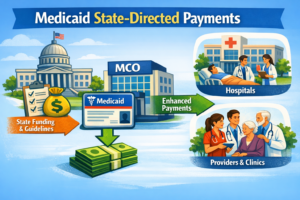 Proposed Medicaid State-Directed Payment Regulation
CMS has published a proposed rule that seeks to establish new limits on how much money states can direct to providers through Medicaid state-directed payments (SDPs) – a mechanism through which state Medicaid agencies instruct Medicaid managed care organizations to pay specific providers state-mandated rates. The rule seeks to implement the “Working Families Tax Cut Act,” a portion of H.R. 1, last year’s federal budget reconciliation bill.
Highlights of the proposed rule include:
- New limits on Medicaid managed care payments that would apply only to SDPs. Managed care organizations would continue to be permitted to make non-directed payments above the Medicare rate in accordance with current federal Medicaid law but SDPs would be limited to 100 percent of the published Medicare rate in Medicaid expansion states and 110 percent of the published Medicare rate in non-expansion states.
- Only payment amounts in approved preprints submitted prior to July 4, 2025 for the following years are eligible to be grandfathered: calendar year 2024, state fiscal year 2025, calendar year 2025, state fiscal year 2026, and calendar year 2026.
- CMS’s proposal aligns with guidance previously issued to states regarding grandfathering certain existing payments. It would institute an annual reduction to the grandfathered payment amount of 10 percent of the initial grandfathered dollar amount but grandfathered payments would not be permitted to exceed the average commercial rate.
- CMS proposes permitting states to continue making grandfathered payments through separate payment terms until those payments are reduced to the Medicare payment cap. At that point, payments would not be permitted through separate payment terms.
- States would not be permitted to make SDPs that are uniform rate increases other than grandfathered payments. The rule would prohibit grandfathered SDPs that are uniform rate increases once those payments are reduced below the grandfathering threshold.
- CMS proposes applying Medicare limits to SDP payments for all providers as of January 1, 2029 with no phase-in or grandfathering.
- CMS proposes calculating the Medicare payment cap on a hospital-specific/service-specific level by using the Medicare PRICER (a CMS software tool that estimates how much Medicare will reimburse providers for specific services) to identify the published Medicare rate for a service including all adjustments. This calculation would not be an aggregate cap on payments.
- For providers that are reimbursed on a cost basis under Medicare, CMS proposes using a cost-basis as payment limits but has asked for stakeholder comment on whether it should use published Medicare fee schedule pricing or the Medicaid fee-for-service rate as the appropriate cap for these providers.
- For services for which there is no Medicare published rate, CMS proposes using the approved Medicaid fee-for-service rate.
- CMS proposes conforming changes to certain non-uniform Medicaid fee-for-service payments that states may currently make to practitioners up to the average commercial rate. This new restriction would not apply to any services that are already subject to federal caps on Medicaid spending, such as inpatient hospital services and outpatient hospital services.
CMS estimates that implementation of this rule as proposed would reduce overall Medicaid spending by $775 billion over the next ten years.
Learn more about the proposed rule from this CMS news release, an accompanying CMS fact sheet, and a preview version of the proposed rule. The deadline for stakeholders to submit comments will be 60 days after the proposed rule’s official publication, which is currently scheduled for Friday, May 22.
Final Affordable Care Act Regulation for 2027
 CMS has issued its annual “Notice of Benefit and Payment Parameters for 2027; Basic Health Program,” which governs health plans offered through the federal health insurance exchange and state exchanges. Major provisions include:
- Eliminating the requirement that insurers offer standardized health plans at each of the traditional plan levels (bronze, silver, gold, and platinum) in favor of permitting insurers to offer unlimited numbers of plans at each level.
- Introducing a new non-network plan option in which insurers can offer exchange plans that have no provider networks, with the plans setting fixed-amount payments for specific medical services. This will take effect in 2028.
- Permitting people to enroll in catastrophic health plans that offer fewer benefits at lower monthly premiums but requiring much greater cost-sharing and permitting such enrollment for up to ten consecutive years. CMS also has expanded the criteria for the hardship exemption required to enroll in catastrophic plans.
- Reducing eligibility for tax credits to help pay for exchange plans and limiting that eligibility to citizens and “lawful immigrants” while excluding refugees, asylum recipients, and others.
- Introducing more rigorous review of eligibility for individuals applying for tax credits and those seeking to enroll in plans during special enrollment periods.
Learn more about the changes CMS will implement for activity governed by the Affordable Care Act in 2027 from this CMS news release; an accompanying CMS fact sheet; and the final CMS rule.
The White House
The White House has announced that 600 generic medications are now listed on the TrumpRx web site and that discounts offered by Amazon Pharmacy, Cost Plus Drugs, and GoodRx have been integrated into the TrumpRx site. Learn more from this White House fact sheet and from the TrumpRx site.
 Centers for Medicare & Medicaid Services (CMS)
- CMS has posted its electronic clinical quality measure (eCQM) specifications for the 2027 reporting/performance period for inpatient hospital, outpatient hospital, and eligible clinician quality reporting programs. Learn more about the release and find links to the 2027 eCQMs from this CMS notice.
- CMS has posted its draft 2027 CMS Quality Reporting Document Architecture (QRDA) Category III Implementation Guide (IG), Schematron, and Sample File for Eligible Clinicians. The draft outlines the requirements for reporting electronic clinical quality measures (eCQMs) for the 2027 calendar year reporting period. The deadline for submitting comments is June 8. Find a link to the draft and additional information about the draft in this CMS notice.
- CMS has added the following items to its Quality Payment Program resource library. (Note: clicking these links may give a prompt to download a file that may be a zip file.)
-
- 2026 MIPS Automatic Extreme and Uncontrollable Circumstances Policy Fact Sheet
- 2026 Qualified Registries Qualified Posting
- 2026 Qualified Clinical Data Registries (QCDRs) Qualified Posting
- 2026 MVP Registration Guide
- 2024 QPP Public Use File Methodology
- 2024 QPP Public Use File Data Dictionary
- 2024 QPP Participation and Performance Results At-A-Glance
- 2024 QPP Data Use Guide
- CMS has posted a bulletin presenting the quarterly update of its clinical laboratory fee schedule and clinical laboratory improvement amendments, including HCPCS codes, waived tests, and reasonable charge payments. Find that bulletin here. The changes it presents take effect on July 1.
- CMS has sent a memo to state survey agencies about the relocation and revision of its surveyor guidance for end-stage renal disease (ESRD) facilities. In addition to relocating its interpretive guidance and survey procedures within the State Operations Manual, CMS has updated its guidance and survey procedures to reflect regulatory changes and guidance that have previously been released through other agency memos and presents technical updates that clarify requirements and expectations for ESRD facilities. While the new information is intended for state survey agencies, the changes could have implications for ESRD providers as well. Learn more from CMS’s memo to state survey agencies about ESRD facilities.
 Department of Health and Human Services
- HHS and its Office of the Assistant Secretary for Financial Resources (ASFR) have announced the launch of AERO: the Audit Enforcement and Risk Oversight initiative. AERO will be a department-wide program integrity effort that seeks to hold states and grantees accountable for audit non-compliance. In a letter to all 50 state governors and treasurers, HHS explained that ASFR is conducting a comprehensive, ongoing analysis of single audit information, examining at least five years of audit history, with initial findings identifying states and grantees that have consistently failed to remedy serious internal control issues. Among the tools the agency envisions using to enforce compliance are temporarily withholding payments; disallowing costs for activities associated with non-compliance; suspending or terminating awards; initiating suspension or debarment proceedings; withholding future federal funds; and pursuing other legally available remedies. Learn more about HHS’s plans and how it intends to pursue these objectives from this HHS news release.
- HHS’s Office of the Assistant Secretary for Planning and Evaluation (ASPE) has published an issue brief on the state of rural hospitals across the U.S. from 2012 to 2023. The report’s rural hospital dashboard enables users to view more detailed hospital-level information, including occupancy rates, number of beds, Medicare and Medicaid share of discharges, liability-to-asset ratios, and annual profit margins. For more information, find the report here, the dashboard here, and the user guide here.
- HHS has announced the reorganization of its Office for Civil Rights (OCR), moving the office to a program-based structure that aligns what HHS views as its three critical substantive areas with three distinct subject-matter divisions: the Conscience and Religious Freedom Division, the Civil Rights Division, and the Health Information Privacy, Data, and Cybersecurity Division. According to the HHS announcement, the reorganization “…will improve OCR’s effectiveness and efficiency to advance the protection of conscience rights, address race-based discrimination in a color-blind manner, eradicate antisemitism and anti-Christian bias, and restore biological truth.” Learn more from this HHS news release.
- HHS’s Substance Abuse and Mental Health Services Administration (SAMHSA) has awarded $255 million to the organization Vibrant Emotional Health to administer the 988 Suicide & Crisis Lifeline, a national network of more than 200 local crisis contact centers managed by a SAMHSA-funded network administrator. At the same time, SAMHSA also announced more than $28 million in new funding opportunities. Learn more about the 988 Suicide & Crisis Lifeline and the new funding now available from this HHS news release.
 HHS/Office of the Inspector General (OIG)
- HHS’s OIG has issued an unfavorable opinion regarding a proposed arrangement in which an orthopedic medical technology company would enter into agreements with individuals – often physicians – who would provide consulting services for its product lines. Find that opinion here.
- The OIG has issued a favorable opinion regarding an arrangement under which a precision oncology company provides consenting patients a supplemental report at no cost in connection with a cancer screening test. Find that opinion here.
- The OIG has issued a report on the effects of vertical integration in Medicare Part D on sponsors’ drug costs, pharmacy reimbursement, and enrollee cost-sharing. Learn what the OIG found in this report.
Medicaid State Plan Amendments
CMS has approved the following state plan amendments for Medicaid and CHIP programs.
- To California, updating the Current Dental Terminology (CDT) dental codes to align the 2026 code set and updating the codes eligible for dental supplemental payments accordingly.
- To Louisiana, amending provisions governing children and adult mental health services to expand the provider types authorized to deliver therapeutic services and to remove the face-to-face requirement for peer support services.
- To Louisiana, amending provisions governing reimbursement methodology for intermediate-care facilities for individuals with intellectual disabilities (ICF/IID), removing the one-time lump sum payment language for all privately owned or operated ICF/IID that billed Medicaid between August 1, 2024 and October 31, 2024 and are active and Medicaid-certified at the time of payment.
- To Michigan, adding addictionologists to the health home staffing structure along with adjusting the FTE to the peer recovery coach and community health worker line item. This update will reflect current roles and responsibilities in the model. The state’s Medicaid program is planning to adjust the current case rate based on the added roles and responsibilities for the substance use disorder health home.
 To Missouri, updating the state’s school-based reimbursement methodology to align with CMS guidance using a cost-based payment approach.
- To Montana, updating the nursing facility reimbursement rate and the requirements for nursing home staffing report quality and performance data.
- To Nevada, revising provider qualification requirements for community health workers by removing the Nevada Certification Board as the sole required certification source and expanding eligibility to include certifications from all Nevada Medicaid-approved community health worker training programs.
- To Nevada, continuing the authority for the Indigent Accident Fund program, a supplemental payment program based on inpatient hospital utilization, to preserve access to inpatient hospital services through state FY 2026.
- To Nevada, expanding adult dental coverage to include diagnostic, preventive, periodontal, and operative (fillings and crowns) services subject to a $1,000 cap.
- To New Hampshire, updating procedure codes for physicians and other licensed practitioner fee schedules.
- To New Jersey, revising the distribution of graduate medical education supplemental trauma payments for state FY 2026.
- To New Jersey, revising the distribution of graduate medical education supplemental payments for state FY 2026.
- To New Jersey, revising the distribution of graduate medical education and indirect medical education payments for state FY 2026.
- To Oklahoma, revising residential substance use disorder state plan pages to reflect the American Society of Addiction Medicine’s updates that include service descriptions for level of care 3.7, covered services and provider qualifications, and placement criteria for reimbursement.
- To Oklahoma, increasing reimbursement rates for Children First targeted case management and nursing assessment services.
- To Virginia, updating language regarding income and eligibility verification systems procedures.
- To Washington, making a technical correction that was submitted to remove outdated reimbursement language.
 HHS Newsletters, Reports, and Videos
- CMS – MLN Connects – May 21
- CMS – CMS has posted a video to help providers determine whether their lab needs to report to CMS through the Clinical Lab Fee Schedule data collection process. Find that video here.
- Center for Medicare and Medicaid Innovation (CMMI) – late last month, CMMI held a webinar presenting an overview of its Innovation in Behavioral Health (IBH) Model, addressing practice participant eligibility and requirements, payment design and methodology, application and submission information, and additional resources. Now, the agency has posted a video of that webinar; find it here.
- Health Resources and Services Administration (HRSA) – Office for the Advancement of Telehealth Announcements – May 18 and May 19
- HRSA – HRSA has posted two videos of technical assistance webinars for its Rural Communities Opioid Response Program’s notice of funding opportunity. Find the planning video here and the program impact video here.
- HRSA – March 13 meeting of the executive committee of the Organ Procurement and Transplantation Network – video
- CDC – Morbidity and Mortality Weekly Report (MMWR) – May 14 and May 21
- “Increase in Travel-Associated and Locally Acquired Dengue Cases – United States, 2024”
- “Knowledge, Attitudes, and Practices Regarding Avian Influenza Among Owners of Backyard Flocks – United States, July–December 2025”
- “CDC Operational Guidance for Investigating Locally Acquired Mosquito-Transmitted Malaria – United States, 2026”
- HHS Office of the Inspector General – weekly “This Week With HHS-OIG” video
 Centers for Disease Control and Prevention (CDC)
- The CDC issued a health alert to inform clinicians and health departments about testing available for patients with suspected hantavirus infection and Andes virus (a strain of hantavirus). For more information, see the update here, the CDC’s hantavirus information page here, and its Andes virus information page here.
- The CDC has established a web page through which to share information about the recent outbreak of Ebola in the Democratic Republic of the Congo and Uganda. To date, no cases of Ebola have been reported in the U.S. as a result of this outbreak and the CDC considers the overall risk to the American public and travelers to be low. As a precautionary measure, the CDC and the Department of Homeland Security have implemented enhanced travel screening, entry restrictions, and public health measures to prevent Ebola from entering the U.S. Learn more about the outbreak and the CDC’s response to it and find resources for diagnosing and treating the disease from the CDC’s Ebola outbreak web page.
- Reinforcing its concern about Ebola, the CDC issued an order banning from entry to the U.S. “covered aliens” who have departed from, or were otherwise present within, the Democratic Republic of the Congo, Uganda, or South Sudan during the last 21 days regardless of their country of origin. Find that order here.
 Stakeholder Events
CMS – HCPCS Level II Public Meetings – June 1
CMS will hold its 2026 HCPCS level II public meeting, in person and virtually, on June 1, 2026 at 9:00 (eastern), with an overflow date of Tuesday, June 2, 2026 to be held virtually, if necessary, to discuss CMS’s preliminary coding, Medicare benefit category, and Medicare payment determinations. Learn more about the meeting, including how to submit questions and comments and register to participate, from this CMS notice.
MedPAC – Commissioners Meeting – September 3-4
MedPAC’s commissioners will hold their next public meeting virtually on Thursday, September 3 and Friday, September 4. An agenda for the meeting and information about how to participate have not yet been posted; when they are, they will be found here.
MACPAC – Commissioners Meeting – September 24-25
MACPAC’s commissioners will hold their next public meeting on Thursday, September 24 and Friday, September 25. An agenda for the meeting and information about how to participate have not yet been posted; when they are, they will be found here.